In 2024, the benefits of digital technology remained out of reach for around 2.6 billion people, about a third of the world’s population. Closing that gap was at the heart of the Global Digital Compact, whose negotiations Zambia and Sweden co-facilitated.
Consultations in China
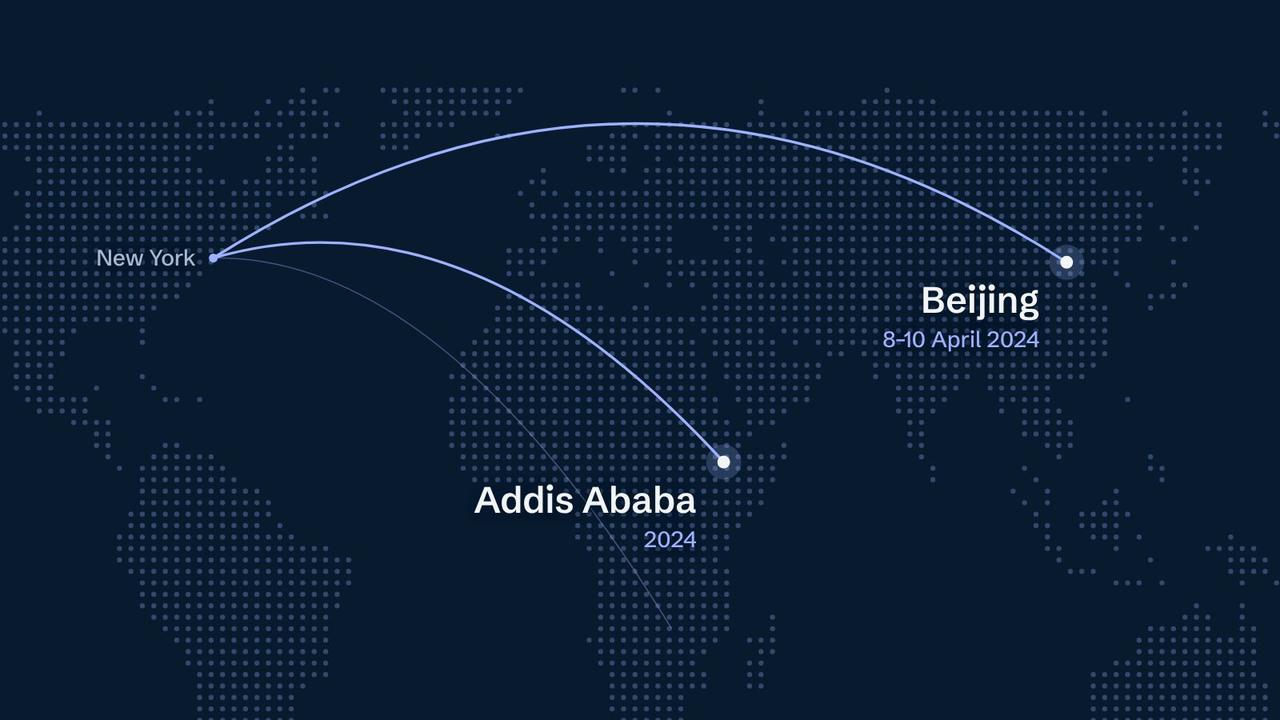
From 8 to 10 April 2024 I was part of the Global Digital Compact team that visited China for stakeholder consultations, led by the co-facilitators: Zambia’s Permanent Representative, Ambassador Chola Milambo, and Sweden’s Permanent Representative, Ambassador Anna Karin Eneström.
On 9 April the China Internet Governance Forum hosted a symposium on the Compact, co-organised by the Internet Society of China and Huawei Technologies. Discussion ranged across universal access and the digital divide, connectivity and fair trade, the role of the UN Internet Governance Forum, AI governance and network security, with government bodies, universities, research institutes and technology companies taking part.
Data, in Addis Ababa
At the headquarters of the UN Economic Commission for Africa in Addis Ababa, I attended a data deep-dive on the Compact organised by the United Nations University and opened by Ethiopia’s Minister of State for Innovation and Technology, H.E. Yeshurun Alemayehu. It brought together the co-facilitators and leading African data experts to review what the Compact could unlock, and to support the African Union’s parallel work on an African Digital Compact.
The zero draft of the Compact was released on 1 April 2024.
Data is the bedrock of new technologies such as AI, and critical to decision-making, sustainable development and modern economies. The zero draft called for stronger data governance frameworks to protect privacy and secure data, for agreed definitions and standards, and for responsible cross-border data flows.
Two shifts that shape this century
Two seismic shifts will shape the twenty-first century: the climate crisis and digital transformation. The Compact was the UN’s response to the second, setting out shared principles for an open, free and secure digital future. World leaders adopted it on 22 September 2024.
How the world got to a Global Digital Compact
Two decades of UN digital cooperation, from the World Summit on the Information Society to the Compact’s first review. Choose a milestone.
- 2003–2005: World Summit on the Information Society. Meeting in Geneva and then Tunis, governments commit to a people-centred, inclusive and development-oriented information society. The Tunis Agenda creates the Internet Governance Forum.
- June 2019: High-level Panel on Digital Cooperation. The Secretary-General’s panel reports on how the world can work together to realise the benefits of digital technologies and limit the risks.
- 2020: Roadmap for Digital Cooperation. The Secretary-General sets out actions on connectivity, digital public goods, inclusion, human rights, trust and security.
- 2021: Our Common Agenda. The Secretary-General proposes a Global Digital Compact, to be agreed at a Summit of the Future in September 2024, involving all stakeholders.
- 10 October 2023: Sweden and Zambia lead the talks. The President of the General Assembly appoints the Permanent Representatives of Sweden and Zambia as co-facilitators of the intergovernmental process.
- 1 April 2024: The zero draft. The first text goes to Member States. Consultations follow in New York and in capitals, from Brasília to Beijing and Addis Ababa.
- 22 September 2024: The Compact is adopted. World leaders adopt the Global Digital Compact at the Summit of the Future, as an annex to the Pact for the Future.
- 26 August 2025: AI Panel and Dialogue established. Resolution 79/325, adopted by consensus, sets up the Independent International Scientific Panel on AI and the Global Dialogue on AI Governance.
- 17 December 2025: WSIS+20 review. The General Assembly completes its 20-year review of the World Summit on the Information Society and makes the Internet Governance Forum permanent.
- 6–7 July 2026: First Global Dialogue on AI Governance. All countries meet in Geneva, alongside the AI for Good Global Summit, with the Scientific Panel’s preliminary report as a shared evidence base.
- 3–4 May 2027: Second Global Dialogue, New York. The Dialogue moves to UN Headquarters, alongside the forum on science, technology and innovation for the SDGs.
- UNGA 82, 2027: High-level review of the Compact. Member States assess progress against the Compact’s objectives, based on a progress report by the Secretary-General.