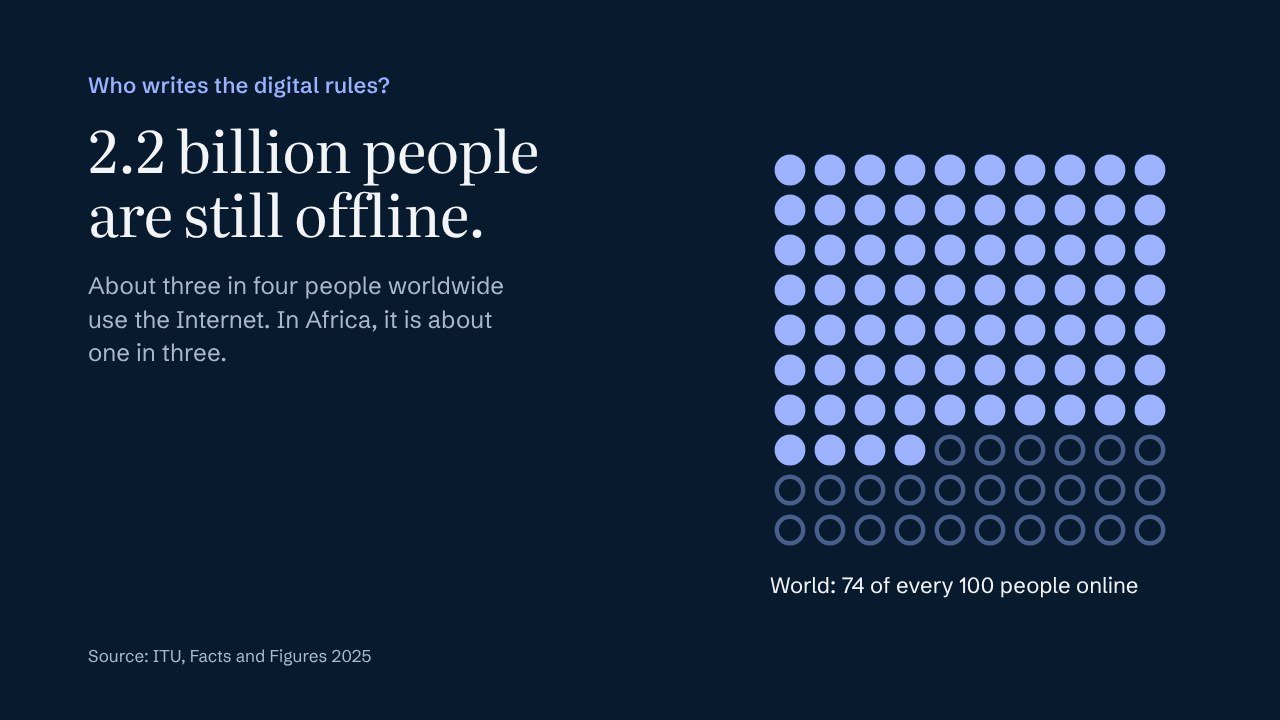
If the world were 100 people
How many would be online in 2025? Choose a group.
| Group | Online, of every 100 people |
|---|---|
| World | 74 |
| High-income countries | 94 |
| Asia-Pacific | 77 |
| Arab States | 70 |
| Landlocked developing countries | 38 |
| Africa | 36 |
| Least developed countries | 34 |
| Low-income countries | 23 |
Source: International Telecommunication Union, Facts and Figures 2025. 2.2 billion people remain offline.
How the world got to a Global Digital Compact
Two decades of UN digital cooperation, from the World Summit on the Information Society to the Compact’s first review. Choose a milestone.
- 2003–2005: World Summit on the Information Society. Meeting in Geneva and then Tunis, governments commit to a people-centred, inclusive and development-oriented information society. The Tunis Agenda creates the Internet Governance Forum.
- June 2019: High-level Panel on Digital Cooperation. The Secretary-General’s panel reports on how the world can work together to realise the benefits of digital technologies and limit the risks.
- 2020: Roadmap for Digital Cooperation. The Secretary-General sets out actions on connectivity, digital public goods, inclusion, human rights, trust and security.
- 2021: Our Common Agenda. The Secretary-General proposes a Global Digital Compact, to be agreed at a Summit of the Future in September 2024, involving all stakeholders.
- 10 October 2023: Sweden and Zambia lead the talks. The President of the General Assembly appoints the Permanent Representatives of Sweden and Zambia as co-facilitators of the intergovernmental process.
- 1 April 2024: The zero draft. The first text goes to Member States. Consultations follow in New York and in capitals, from Brasília to Beijing and Addis Ababa.
- 22 September 2024: The Compact is adopted. World leaders adopt the Global Digital Compact at the Summit of the Future, as an annex to the Pact for the Future.
- 26 August 2025: AI Panel and Dialogue established. Resolution 79/325, adopted by consensus, sets up the Independent International Scientific Panel on AI and the Global Dialogue on AI Governance.
- 17 December 2025: WSIS+20 review. The General Assembly completes its 20-year review of the World Summit on the Information Society and makes the Internet Governance Forum permanent.
- 6–7 July 2026: First Global Dialogue on AI Governance. All countries meet in Geneva, alongside the AI for Good Global Summit, with the Scientific Panel’s preliminary report as a shared evidence base.
- 3–4 May 2027: Second Global Dialogue, New York. The Dialogue moves to UN Headquarters, alongside the forum on science, technology and innovation for the SDGs.
- UNGA 82, 2027: High-level review of the Compact. Member States assess progress against the Compact’s objectives, based on a progress report by the Secretary-General.
Who governs AI at the United Nations
The Global Digital Compact created two new bodies and a track for capacity-building. Choose a part to see what it does.
- Global Digital Compact (September 2024)
- Leaders agree to establish an independent scientific panel and a global dialogue on AI, and to develop AI capacity-building partnerships, including options for a Global Fund on AI.
- Resolution 79/325 (26 August 2025)
- Adopted by consensus. It sets the terms of reference and ways of working for both new bodies.
- Scientific Panel on AI (40 members)
- The first global scientific body on AI. Its members were appointed in February 2026, and its preliminary report gave the first Dialogue a shared evidence base.
- Global Dialogue on AI Governance (Geneva 2026, New York 2027)
- A universal forum where every country has a seat. The first session met in Geneva on 6–7 July 2026; the second is in New York on 3–4 May 2027.
- High-level review (UNGA 82, 2027)
- Leaders review progress on the whole Compact, including its commitments on AI.
- Capacity-building (Since December 2024)
- The Group of Friends for International Cooperation on AI Capacity-Building, co-chaired by Zambia and China, works to make sure countries can take part in AI governance and benefit from AI, not only discuss it.
Two UN tracks for a safer cyberspace
States work on cyber questions in two places: one on peace and security between States, one on crime. Switch tracks to follow each.
Peace and security
First Committee, with the UN Office for Disarmament Affairs
- 2015: Eleven norms. A group of governmental experts recommends 11 voluntary, non-binding norms of responsible State behaviour. The General Assembly calls on States to be guided by the report.
- 2021–2025: Open-ended working group. All Member States meet over eleven substantive sessions on threats, norms, international law, confidence-building and capacity-building.
- May 2024: Points of Contact Directory. A global directory lets States reach each other directly during ICT incidents, a practical confidence-building measure.
- July 2025: Consensus final report. The working group agrees to replace itself with a permanent body: the Global Mechanism on ICTs in the context of international security.
- March 2026: Global Mechanism begins. An organisational session on 30–31 March 2026 is followed by the first substantive plenary in July.
- December 2026: Thematic groups. Dedicated thematic groups meet on 7–11 December 2026.
Crime and justice
Third Committee, with the UN Office on Drugs and Crime
- 2019: Negotiations begin. The General Assembly sets up an ad hoc committee to draft a convention on countering the use of ICTs for criminal purposes.
- 24 December 2024: Convention adopted. The General Assembly adopts the UN Convention against Cybercrime without a vote: the first global treaty on cybercrime.
- 25–26 October 2025: Signing in Hanoi. More than 70 countries sign at the ceremony in Hanoi. The Convention enters into force 90 days after the 40th ratification.
- 26–30 January 2026: Rules of procedure. The Ad Hoc Committee meets in Vienna to draft rules for the Conference of the States Parties. States do not yet reach agreement.
- 31 December 2026: Signature closes. The Convention stays open for signature at UN Headquarters in New York until the end of 2026.
- January 2027: Back to Vienna. The Ad Hoc Committee’s next session.
Who writes the digital rules?
A one-minute explainer: the digital divide, the Global Digital Compact, AI governance and cybersecurity at the UN. Choose a chapter to jump to it.
Each explainer works with a keyboard and a screen reader, and has a text version for readers without JavaScript. Sources: International Telecommunication Union; UN Office for Digital and Emerging Technologies; UN Office for Disarmament Affairs; UN Office on Drugs and Crime; General Assembly resolutions 70/237, 79/1, 79/243, 79/325 and 80/173. Dates are as of November 2026.