On 3 December 2024 a Group of Friends for International Cooperation on Artificial Intelligence Capacity-Building was launched at the United Nations in New York, co-chaired by Zambia and China. Zambia was represented by Ms Prudence Kaoma, then Acting Permanent Secretary in the Ministry of Finance and National Planning, and China by its Permanent Representative, Ambassador Fu Cong. I was part of Zambia’s delegation.
The partnership brings together perspectives from the Global South and a leading AI technology nation. That matters. Many developing countries are not yet fully engaged in, or benefiting from, advances in AI, and the gap could widen global inequality. A shared platform helps countries exchange practice, pool resources and make AI development more inclusive.
A week at Tsinghua University
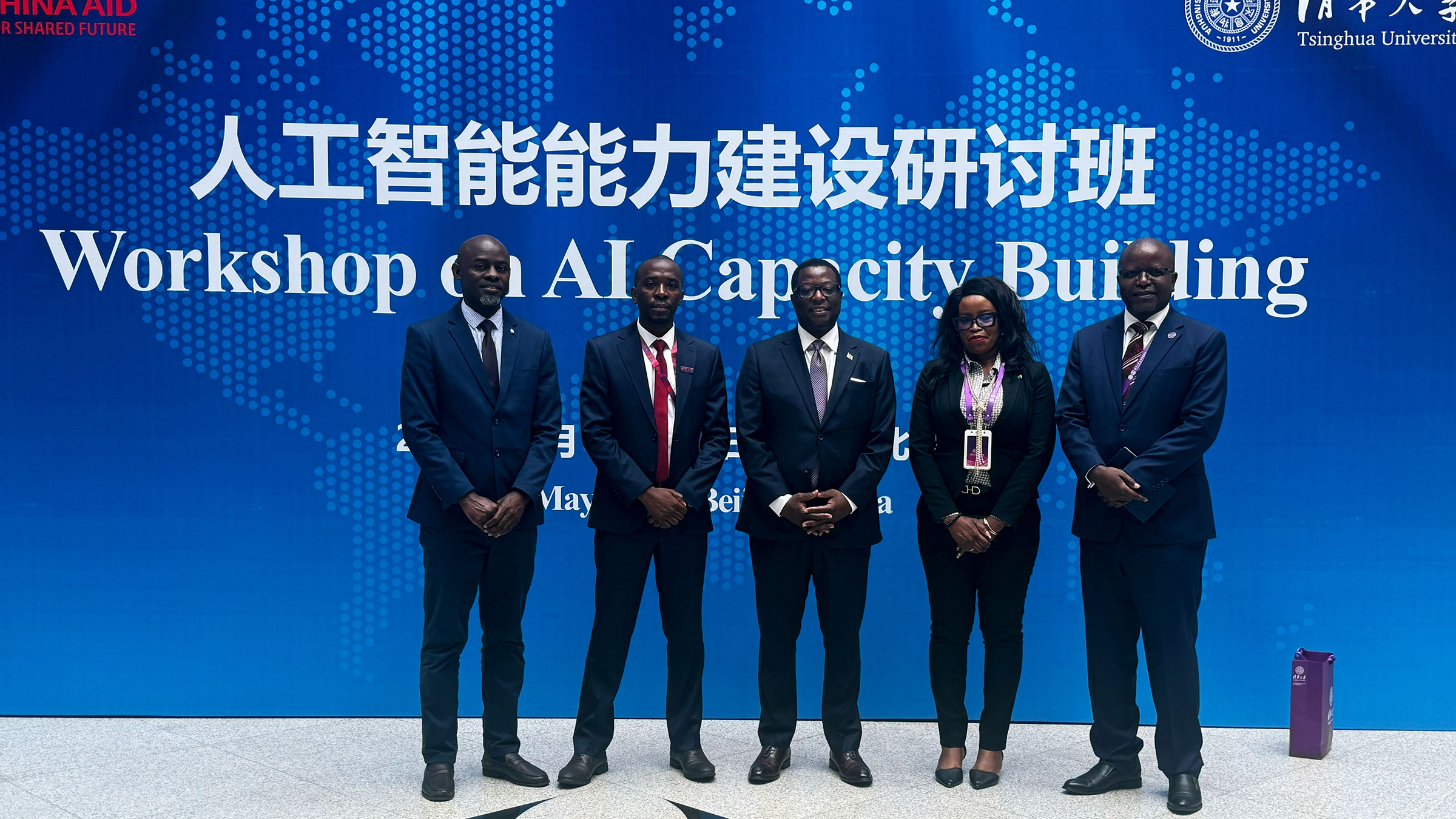
The Second Workshop on AI Capacity Building opened at Tsinghua University on 12 May 2025.
In May 2025 I was in Beijing for the Second Workshop on AI Capacity Building, a six-day programme hosted by China’s Ministry of Foreign Affairs at Tsinghua University, with representatives of nearly 40 countries and regional organisations.
Vice Foreign Minister Ma Zhaoxu opened the workshop, stressing the importance of an open and fair environment for AI development. Zambia’s Permanent Representative, Ambassador Chola Milambo, Co-Chair of the Group of Friends, highlighted the need for Global South collaboration, regional knowledge centres and equitable governance frameworks, so that AI has a positive impact for all of humanity.
Capacity-building is not a side issue in AI governance. It decides who gets to take part.
Who governs AI at the United Nations
The Global Digital Compact created two new bodies and a track for capacity-building. Choose a part to see what it does.
- Global Digital Compact (September 2024)
- Leaders agree to establish an independent scientific panel and a global dialogue on AI, and to develop AI capacity-building partnerships, including options for a Global Fund on AI.
- Resolution 79/325 (26 August 2025)
- Adopted by consensus. It sets the terms of reference and ways of working for both new bodies.
- Scientific Panel on AI (40 members)
- The first global scientific body on AI. Its members were appointed in February 2026, and its preliminary report gave the first Dialogue a shared evidence base.
- Global Dialogue on AI Governance (Geneva 2026, New York 2027)
- A universal forum where every country has a seat. The first session met in Geneva on 6–7 July 2026; the second is in New York on 3–4 May 2027.
- High-level review (UNGA 82, 2027)
- Leaders review progress on the whole Compact, including its commitments on AI.
- Capacity-building (Since December 2024)
- The Group of Friends for International Cooperation on AI Capacity-Building, co-chaired by Zambia and China, works to make sure countries can take part in AI governance and benefit from AI, not only discuss it.